

There's a new tool in the AI transcription space, and it comes with a name that deserves a proper introduction.
DUB-DUB.ai (www.dub-dub.ai, pronounced as DUB dash DUB or DUB DUB) is the latest product to come out of CORTiX.io, and it's built to do something deceptively simple: turn audio and video files into accurate transcripts, subtitles, and translations — across 150+ languages — at a flat $10/hour rate, with zero data training on your content. Ever.
That last part matters more than it might seem. But let's start with the name, because if you've been searching for it, you've probably found something else entirely.
Wait — Isn't "DubDub" Already a Thing?
Yes. And no. And that's exactly why this needs clearing up.
Search for anything resembling "dub dub AI" online and you'll land in a crowded neighbourhood of similarly named tools, each doing something quite different. Here's a quick breakdown of who's who:
dubdub.ai — An AI dubbing platform founded in 2021 in Bangalore, India, focused on automated video translation with AI-generated voiceovers in 40+ languages. In March 2025, it was acquired by Observe.AI. It's a dubbing and voiceover tool, not a transcription platform. Not related to DUB-DUB.ai.
DupDub (dupdub.com) — A Singapore-based AI voice cloning and content creation suite operated by Mobvoi PTE. It covers voiceovers, writing tools, video editing, and AI painting. Their aggressive black-hat SEO practises propel them to rank high for any format that sounds like DupDub, but rest assured they are entirely not related to DUB-DUB.ai. Comprehensive? Yes. A transcription-first tool? No.
Dubformer — A high-end AI dubbing studio targeting broadcasters and localisation professionals, focusing on emotionally accurate dubbed audio in 140+ languages. Enterprise-oriented and pitched squarely at the media and localisation industry.
Kapwing — A broader video editing platform that includes AI dubbing as one of many features. It serves over 35 million creators and positions itself as an all-in-one content creation suite, with dubbing functionality powered by partners like Google and DeepL.
aidubbing.io — A free-to-use AI dubbing tool with lip-sync capabilities and voice cloning, aimed primarily at marketers, e-commerce, and educational content creators.
dub.ai — A website ran by the government of Dubai to help its citizens to adopt artificial intelligence solutions, using the .ai cunningly to write "Dubai".
Other, non-related websites include trydub.com, dubverse.ai, dubbingai.io, and aidubbing.io.
The common thread: all of these are, in some form or another, dubbing tools — platforms that replace or generate spoken audio in a different language. Some do subtitles as a secondary output. Very few offer the editorial depth of a proper transcription platform.
DUB-DUB.ai is not a dubbing tool. The name rhymes, the vibe is similar, but the product category is meaningfully different. DUB-DUB is a transcription-first platform: you upload audio or video, and it returns accurate, editable transcripts with full speaker identification, subtitle generation and export, and translation — all in one clean workflow.
Now, How Does It Stack Up Against Actual Transcription Tools?
This is where it gets interesting. The transcription and subtitle market is well-established, with several strong players. Here's how DUB-DUB.ai compares to the five most relevant:
1. Sonix
Sonix is a well-regarded transcription platform with strong accuracy, 53+ languages, and a solid suite of editing and collaboration tools. Its pay-as-you-go pricing starts at $10/hour — the same as DUB-DUB.ai. But to unlock lower rates ($5/hour), you'll need a Premium subscription at $22/user/month on top. Features like burn-in subtitles come at extra cost on some plans. Sonix doesn't offer a free plan, and while it has enterprise-grade security with SOC 2 and HIPAA certifications, it operates as a feature-heavy platform that can feel overwhelming for users who just need a clean, fast workflow.
2. Otter.ai
Otter built its reputation on real-time meeting transcription and is deeply integrated with Zoom, Google Meet, and Microsoft Teams. It's genuinely useful for meeting-heavy teams. But it has had a turbulent year on the privacy front: in August 2025, a federal class action lawsuit (Brewer v. Otter.ai) was filed in California, alleging that Otter's bot recorded and transcribed conversations of non-users — people who never signed up for the service — and used that data to train its AI models without explicit consent. The case was consolidated in October 2025 and remains active. Separately, Otter's own privacy page confirms it uses transcripts to train internal models using a "de-identification" method. For anyone with sensitive recordings, that's a material risk.
3. Rev
Rev sits at the premium end: $0.25/minute ($15/hour) for AI transcription, and up to $1.99/minute for human transcription. The quality is there — Rev claims 96%+ AI accuracy — but the cost structure places it out of reach for high-volume or budget-conscious users. It excels as a hybrid AI + human service and has HIPAA compliance, making it strong for legal and medical workflows. For general transcription, subtitling, and translation, the pricing premium is hard to justify.
4. Happy Scribe
Happy Scribe is the strongest multilingual competitor, with 120+ language support, subtitle tooling, and an opt-out from AI training available to users. Its pricing is subscription-based: Free tier, Basic at $8.50/month (annual), Pro at $19/month, and Business at $59/month. The subscription structure makes it economical for heavy users, but the tiered model means features like translation are gated. It recently launched an AI meeting note-taker and has been expanding rapidly. Happy Scribe is a credible, well-rounded platform — particularly for European content teams who prioritise GDPR compliance.
5. Fireflies.ai
Fireflies is first and foremost a meeting intelligence tool. It auto-joins calls, records conversations, and generates structured summaries and CRM-ready insights — it integrates with Salesforce and HubSpot. For sales teams and customer-facing roles, it's genuinely powerful. For media, research, or journalism workflows involving uploaded audio and video files? It's the wrong tool. Speaker diarisation is included, and it supports 100+ languages, but the entire product experience is designed around call recording and deal pipelines, not file-based transcription and subtitle production.
So What Makes DUB-DUB.ai Different?
After mapping the landscape, the position becomes clear. DUB-DUB.ai is designed for a specific use case that the broader market doesn't serve particularly well: accurate, private, affordable transcription with full subtitle production and translation — for people who work with audio and video files, not meeting bots. (Article continues after the image)
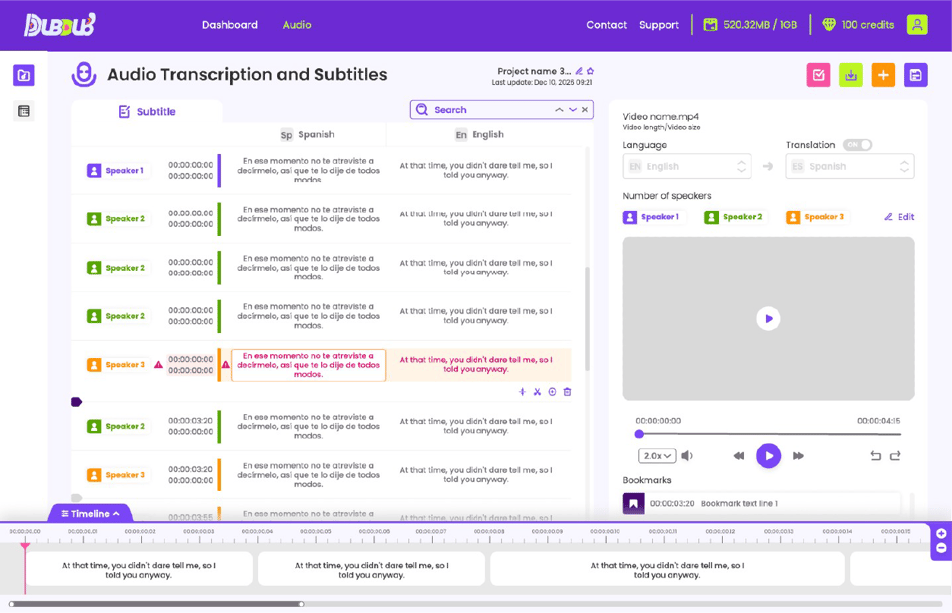
Here's what that looks like in practice:
One flat price. $10/hour. No subscription required to unlock features. No per-seat fees. No tiered feature locks. You upload a file, you pay for what you use, and you get everything: transcription, speaker identification, subtitles, and translation.
150+ languages. That's broader than Sonix (53+), broader than Fireflies' 100+ when it comes to subtitle output, and comparable to Happy Scribe for translation depth.
Speaker diarisation that's actually usable. Automatic speaker detection and labelling is standard in most platforms, but the quality of the editing experience varies enormously. DUB-DUB.ai's interface is built specifically to make reviewing, renaming, and correcting speaker labels feel effortless — no technical knowledge required. For researchers, journalists, and podcast producers who work with multi-person recordings regularly, this is not a minor detail.
Subtitle generation built for publishing. Export as SRT, VTT, or burn directly into MP4. Built around the actual platforms creators use — YouTube, TikTok, Instagram, LinkedIn — rather than treating subtitle export as an afterthought.
Genuine data privacy — not a policy footnote. This is worth dwelling on. DUB-DUB.ai makes a clear, unambiguous commitment: your data is never used to train AI models. Not DUB-DUB's models, not third-party models. Files are processed via private API calls, content is never shared, and there is no "de-identification" workaround. For journalists protecting sources, legal teams handling confidential depositions, researchers managing sensitive interview data, and enterprises with data governance requirements, this is the feature that makes the platform trustworthy rather than merely useful.
API coming soon. DUB-DUB.ai is building toward an MCP-compatible developer API that will allow teams to integrate transcription, subtitle generation, and translation directly into their own pipelines and product stacks — without manual uploads.
The Honest Comparison
| DUB-DUB.ai | Sonix | Otter.ai | Rev | Happy Scribe | Fireflies | |
|---|---|---|---|---|---|---|
| Pricing | $10/hr flat | $10/hr + $22/mo subscription for lower rates | Free tier; subscription from ~$10/mo | $15/hr AI; $119/hr human | Subscription from $8.50/mo | Subscription |
| Languages | 150+ | 53+ | English + 3 | 57+ | 120+ | 100+ |
| Speaker diarisation | ✓ | ✓ | ✓ | ✓ | ✓ | ✓ |
| Subtitle export (SRT/VTT) | ✓ | ✓ | Limited | ✓ | ✓ | Limited |
| Burn-in subtitles (MP4) | ✓ | Extra cost on some plans | ✗ | ✗ | ✗ | ✗ |
| No AI training on your data | ✓ (guaranteed) | Not stated | Uses data to train models | Not stated | Opt-out available | Not stated |
| File-based workflow | ✓ | ✓ | Meeting-first | ✓ | ✓ | Meeting-first |
| Free to start | ✓ | ✗ | ✓ | ✓ (limited) | ✓ | ✓ |
| API access | Coming soon | ✓ | ✓ | ✓ | ✓ | ✓ |
Who Is This Actually For?
DUB-DUB.ai is built for professionals who work with recorded content and need reliable output without complexity or compromise.
Journalists and researchers who conduct interviews and need accurate, speaker-labelled transcripts they can trust not to end up in a training dataset.
Content creators and video producers who need subtitles in multiple languages, fast, without an agency invoice or a complex SaaS subscription.
Legal and compliance teams who transcribe depositions, hearings, or sensitive internal recordings and can't afford ambiguity about where that data goes.
Enterprises and localisation teams who need a clean, scalable workflow for turning multilingual audio and video into publishable content.
Podcasters and media producers who routinely work with multi-speaker recordings and need speaker identification that actually keeps up.
A Note on the Name
The team at CORTiX.io is aware that "DUB-DUB" enters a space with some existing name confusion. The choice is deliberate. "Dub" has long been used in subtitling and transcription contexts alongside its more common dubbing meaning — a "dub" is a copy, a transfer, an edit. The double "dub" signals both the dual nature of the platform (transcript and subtitle) and the efficiency of doing both in a single, streamlined workflow.
It is not dubdub.ai. It is not DupDub. It is not Dubformer. If you're looking for an AI voiceover or audio replacement tool, those platforms exist and serve that use case well.
If you're looking for a transcription platform that produces accurate transcripts, clean speaker identification, publish-ready subtitles, and translations in 150+ languages — at $10/hour, with a hard privacy guarantee — you're in the right place.
DUB-DUB.ai is live now at www.dub-dub.ai. You can start for free.
DUB-DUB.ai is a product of CORTiX.io. For press or partnership enquiries, visit www.cortix.io.